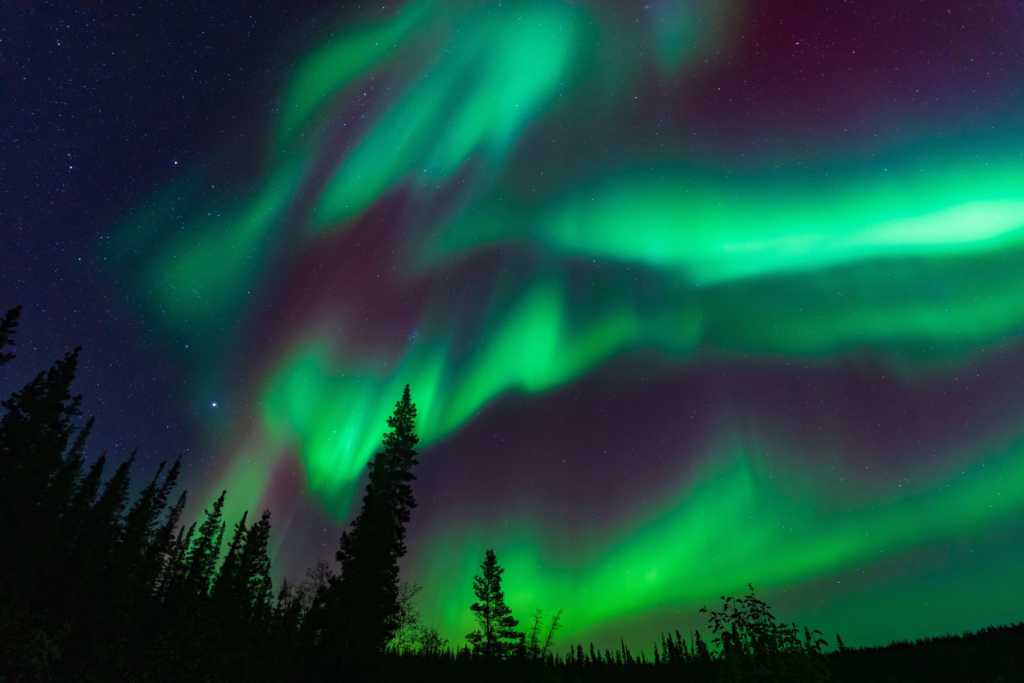

NOAA’s Space Weather Prediction Center is forecasting G1-class geomagnetic storm conditions for tonight and again on Saturday, with the Kp index forecast to reach 4.67 on both nights. The conditions could spark aurora activity across parts of Canada, but this is a relatively weak event, meaning any northern lights displays are more likely to be faint than the dramatic shows often seen in photos.
Tonight’s activity is linked to a September 28 filament eruption that sent a coronal mass ejection toward Earth, while Saturday’s forecast is being driven by a high-speed solar wind stream from a positive-polarity coronal hole.
Despite their different origins, both events are expected to produce similar levels of geomagnetic activity, creating a small chance that aurora activity could become visible farther south than usual, potentially reaching parts of southern Ontario.
What to Expect
At G1 strength, any aurora is likely to appear as a faint green or grey glow low on the northern horizon rather than a vivid overhead display. Light pollution will make viewing difficult in and around Toronto, so the best chance of seeing anything will be from a dark location with a clear view north. Even if the aurora isn’t obvious to the naked eye, a smartphone camera using Night Mode or a long-exposure setting may be able to capture colours and details that are harder to see in real time.
Treat this as a possibility rather than a guarantee. If you’re already in a dark area north of the city after sunset tonight or tomorrow, it may be worth taking a quick look toward the northern horizon.
Those in downtown Toronto may have difficulty seeing any aurora activity due to the combination of light pollution and the storm’s modest strength. Since space weather conditions can change quickly, it’s worth checking NOAA’s latest forecast before heading out.
The Details
- What: Minor G1-class geomagnetic storm with a chance of northern lights activity
- When: Friday, Oct. 2 and Saturday, Oct. 3
- Peak Kp: Around 4.7 on both nights
- Cause (Tonight): Glancing impact from a coronal mass ejection linked to a Sept. 28 solar filament eruption
- Cause (Sunday): High-speed solar wind stream from a positive-polarity coronal hole
- Best Viewing: Dark skies away from city lights with a clear northern horizon
- Toronto Outlook: Light pollution will make viewing difficult
- Photography Tip: Night Mode or long-exposure photos may reveal colours not visible to the naked eye
- Forecast: Conditions can change quickly, so check NOAA updates before heading out