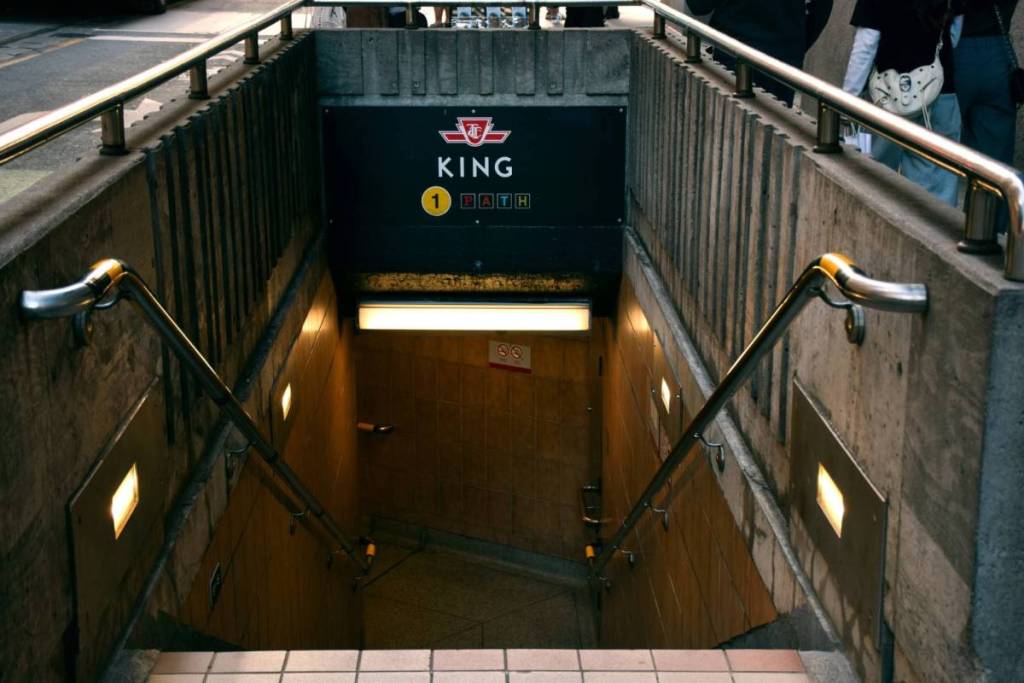

Toronto’s underground city was born out of necessity. With humid summers and bitter winters, developers created a climate-controlled network beneath the city, allowing people to move between buildings, work, shop, and dine without facing the elements.
The idea began in 1900 with a tunnel beneath James Street connecting two sections of Eaton’s department store. More than a century later, that original passage remains part of the network. What started as a practical solution evolved into one of Toronto’s most remarkable hidden spaces.
The network expanded rapidly during the 1960s and 1970s as office towers, shopping concourses, restaurants, and services connected below street level, gradually forming a second city beneath Toronto. Today, the network stretches across much of downtown Toronto, linking Union Station, the Financial District, shopping centres, hotels, office towers, and transit hubs.
Navigating Toronto’s underground city is easier than it first appears thanks to its colour-coded wayfinding system. Throughout the network, blue signs point north, yellow indicates east, red marks south, and orange directs pedestrians west. Once you learn the colours, finding your way through the maze-like corridors becomes surprisingly intuitive.
What makes Toronto’s underground city remarkable is not only its size but everything it contains. Beyond serving as a pedestrian network, it functions as a thriving urban hub where people can shop, dine, work, and access everyday services without stepping outside.
The Hidden City
High-end boutiques sit alongside familiar retailers, while food courts fill with office workers at lunch. Banks, medical clinics, professional services, and public art all contribute to a space that feels less like a passageway and more like a living part of the city.
Winter is when the underground truly shines. As freezing temperatures and wind chills make outdoor travel unpleasant, thousands of people move through heated corridors that connect offices, shops, restaurants, and transit.
For much of the year, downtown workers rely on the network daily. Regular users know the fastest routes, the best lunch spots, and the hidden connections between buildings. Affectionately nicknamed “mole people” by some Torontonians, they have mastered life in this city beneath the city.
For first-time visitors, the underground can feel like a maze. The network is vast, the corridors often look alike, and getting lost is almost inevitable. Yet that is part of the experience. Wandering the tunnels often leads to unexpected discoveries, from hidden shops and local eateries to connections you never knew existed.
Regular users navigate with ease, and newcomers quickly learn an unwritten rule: when in doubt, follow the people who look like they know where they’re going. Before long, the network’s logic begins to reveal itself.
Interactive maps are available for those who want guidance, but the best way to understand the underground is simply to explore. Follow a corridor and see where it leads. More often than not, you will emerge at a subway station, office tower, shopping concourse, public space, or unexpected piece of art.
What first seems overwhelming gradually reveals a surprisingly logical design. Beneath Toronto’s streets lies a 30-kilometre network shaped by more than a century of growth—a place where history meets modern convenience and where a practical response to the city’s climate became one of its most fascinating hidden spaces.
The Need To Know Details
- What: World’s largest underground pedestrian shopping complex. 30 kilometres of interconnected tunnels, walkways, and shopping concourses. 1,200+ stores, restaurants, and services. Approximately 4 million square feet (371,000 square metres) of retail space. Connects more than 75 buildings across downtown Toronto. Operates year-round, climate-controlled
- Navigation system: Colour-coded directional system: blue signs point north, yellow indicates east, red marks south, and orange directs pedestrians west. Interactive online map at pathmap.to
- Services & amenities: Banking services, medical offices, legal services, pharmacies, and fitness studios (yoga and Pilates). The network also provides access to a variety of recreational and wellness amenities
- Art & culture: Public art can be found throughout parts of the network, adding creative elements to the underground corridors.
- Weather advantage: Climate-controlled year-round. Summer: avoid Toronto heat and humidity. Winter: avoid dangerous cold and wind chill. Perfect for humid July days and minus-twenty-degree January days