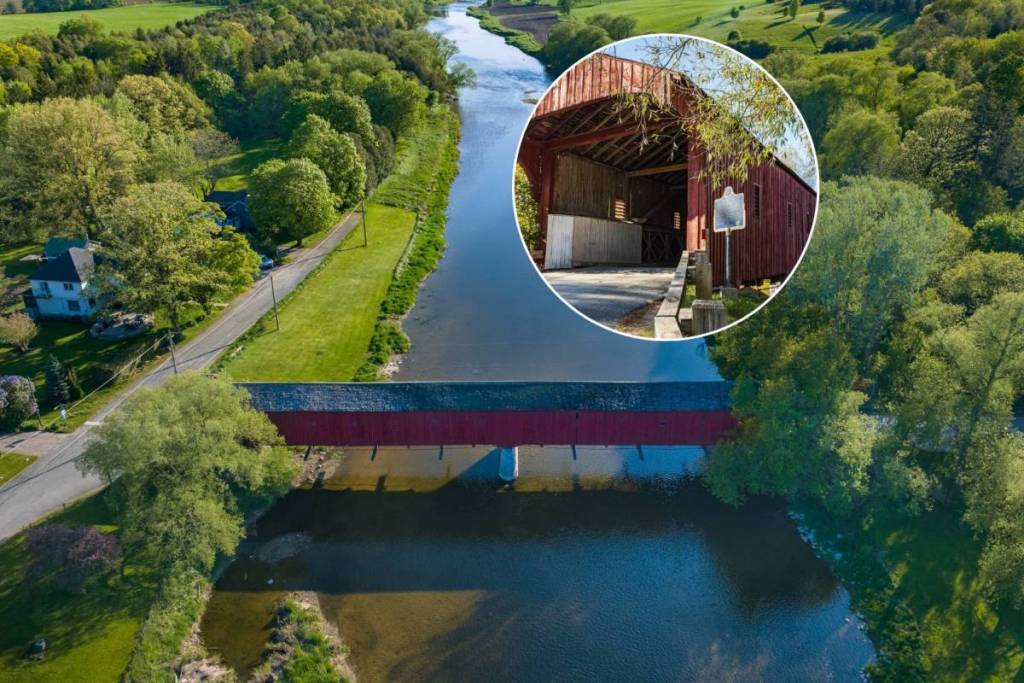

For more than 140 years, locals have driven across its wooden deck, where the exposed timber frame and traditional craftsmanship offer a glimpse into Ontario’s 19th-century engineering heritage.
The tradition of kissing in covered bridges dates back long before the West Montrose Covered Bridge was built. Its enclosed design offered couples a rare sense of privacy. Over generations, the tradition of kissing there earned it the nickname “Kissing Bridge.“
Nearly a century and a half later, it remains part of the bridge’s identity. Offering a quiet, timeless setting where visitors can experience a piece of Ontario folklore for themselves.
Step inside, and the bridge’s craftsmanship becomes impossible to miss. Hand-hewn timber beams, exposed joinery, and the original wooden structure showcase the skill of 19th-century builders. The filtered light and the sound of footsteps on the wooden deck create an atmosphere unlike that of any modern bridge.
Carefully maintained, the West Montrose Covered Bridge has preserved its historic character for well over a century. Therefore, it offers visitors an authentic glimpse into Ontario’s engineering and architectural past.
When open, visiting the West Montrose Covered Bridge is refreshingly simple. There are no admission fees or gates. Just a historic bridge you can walk across or drive over as the Grand River flows beneath. Surrounded by peaceful countryside, it continues to connect two communities just as it has for more than a century. The bridge is currently closed for rehabilitation and is expected to reopen by the end of December 2026.
Unlike many historic landmarks preserved as museum pieces, this bridge remains part of everyday life. Its lasting significance comes not only from being Ontario’s last covered bridge but also from the community’s commitment to preserving it while keeping it in active use.
The Need To Know Details
- Location: 1257 Covered Bridge Dr., West Montrose, Ontario, about 90 minutes from Toronto
- Admission: Free to visit
- Current closure: The bridge is closed to all pedestrians, cyclists, and vehicles as part of a major rehabilitation project and is expected to reopen by the end of December 2026
- Why it’s closed: The Region of Waterloo is carrying out structural repairs to preserve the historic bridge for future generations, including lifting the bridge onto a temporary support structure while key components are restored
- Detour: During construction, travellers should use Line 86 as the alternate route
- Before you go: Check the latest construction updates from the Region of Waterloo before planning your visit, as timelines may change